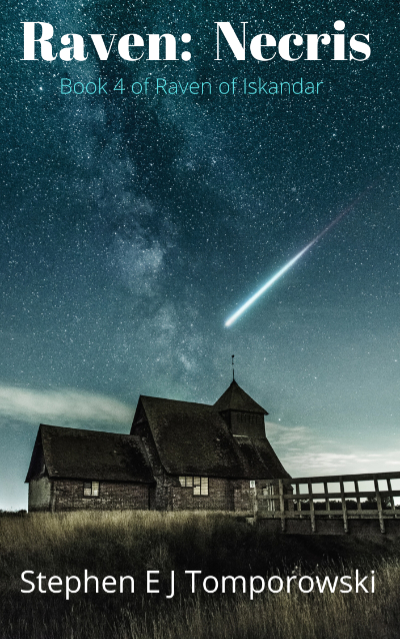
The fourth book of the Raven of Iskandar series, Raven: Necris is on the final edit. I’m going to opt for listing it on Amazon for pre-release.
I’ve gotten an old friend from a previous job, Jonathan Sears to write the Foreword.
I had not originally intended for the series arc to explode during this book, but that is what happened.
Teasers:
More about Raven’s family
One character only mentioned in the previous books, appears
The return of a minor character from Book 1
Grabby’s and Soria’s backstory is revealed
A tourist’s view of the planet Necris
And, a character will die by the end of the book.
Note that although every book has had a preface dealing with Raven in her 100th plus years of life, this book will also have an epilogue. The preface of this book ends with ‘She opened the letter.’ and I didn’t want to have everyone wait until the next book to find out what was in the letter.
So when you read that, hang on! You’ll find out at the end of the book.
When my first book was published (Raven: The Call from Central), I opted for the name ‘Stephen E J Tomporowski’, first because it is my name, second to distinguish myself from another Steve Tomporowski.
The E is for Edward, my birth middle name while the J is for Joseph, which was a confirmation name. That name came in handy, because otherwise my initials would have spelled a word (SET) and caused confusion on documents. When initialing, I always use four initials, SEJT, not just because I want to be unique (don’t we all?) but to avoid the confusion of my initials with a word.
Now you would think that with a name like ‘Tomporowski’ it would be a cinch that I’d have a unique name. Nope, didn’t happen, but it only fell short by one similarity and the habit of search engines of making sure that Stephen, Steven and Steve are equivalent and all show up in the results.
And there’s the problem. There is a Steven M. Tomporowski out there, or rather in there, in jail. Here’s a link to one of the articles on him from 2004:
He got life in prison without hope of parole with the judge calling his crimes “vile, vicious, premeditated and cold-blooded”.
Needless to say, that’s not me and you can understand that I really want to distance myself from this guy with a similar name.
Apparently this guy was also a stand-up comedian of the foul-mouthed kind, probably just a local Illinois phenomenon. I had originally thought that there were two of them out there that I needed to be disassociated from. Subsequently I found out that the killer and the comedian were the same person. Phew!
In a bit of irony, once I was contacted by this guy via email. He was probably 11 or 12 at the time and as you would have guessed (this was the mid-90’s), his email was via AOL and in all caps.
Recently Katy Perry was sued by the Christian rapper Flame about, of all things, a synthesizer riff in the song Dark Horse (2014). The accusation was that that synth riff was stolen from the song Joyful Noise (2008). While there were several irregularities in the proceedings, Katy Perry was found to be guilty of this plagiarism.
Note that this was not the melody, nor was it even in the foreground, but in the background of Dark Horse. Musically it is referred to as an ostinato, or an element to support the melody. Otherwise the songs did not share the same melody, chord progression or drum rhythm.
If you are interested in the whole discussion, you can see it in a short 9 minute video by Adam Neely on Youtube here:
If songwriters are able to copyright short sequences of notes, then we have a big problem. There are only so many keys and so many notes and only so many ways to combine them.
This was the situation that caused another lawyer, Damien Riehl, to ally with a programmer by the name of Noah Rubin to do the unthinkable. They created a program that would generate every possible melody. Once generated, the melodies occupied 2.6 TB of drive space. By copyright law, once those melodies were ‘afixed’ to a physical medium (the hard drive), they are copyrighted.
Adam Neely (again) interviewed the two in a Youtube video here:
Then the duo also did one more unthinkable thing, they made the file available to everyone. If you have 2.6 TB of free drive space and plenty of time to wait, you can get the file here:
Why did they do that? By putting all the music in public domain, now anybody who writes a song has to prove, in a court of law, that they did not have exposure to this file. Pretty difficult to prove a negative. In short, these two have thrown a monkey wrench into the copyright works to show the problems with the current situation with music. In essence, music is demonstrated to be just math with a limited number of possibilities. So, similarities may not be plagiarism but merely the result of the limited mathematical equations that the artist has to work with.
Damien Riehl originally revealed their feat in a TED talk called ‘Copyrighting all the melodies to avoid accidental infringement’. You can find it here:
Back in 2017, Dr Janelle Shane trained a neural network named char-rnn using a list of 2000 proverbs. When it began creating new proverbs, it apparently it had developed an obsession with four legged mammals, like sheep.
You must be logged in to post a comment.